This is our extensive bearded dragon care guide. Reach out to us through the provided contact information if you have more questions. We are always ready to help!
HEATING AND LIGHTING
Bearded dragons require a temperature gradient in their enclosures because they can’t regulate their body temperatures like we can. They have to thermo-regulate, which means that they have to move between areas of differing temperatures in order to regulate their internal temperature. You should have a basking spot for your Bearded dragon that is around 100-115 degrees Fahrenheit, as they need to get their body temp around 95 degrees to digest their food. Your bearded dragon will also need an area to cool down if he gets too warm. At the opposite end of the tank, you should try to keep the temp around 75-85 degrees. Night time temps shouldn’t be allowed to drop below 60 degrees, whereas 70-75 degrees is more comfortable for them. Don’t guess on temps – you could cook or freeze your Bearded dragon! Use a good thermometer, one on the cool side and another near the basking site. (Note: those stick on thermometers are usually not very accurate.)
I never recommend using hot rocks as they are potentially dangerous! They can overheat and produce serious burns or short out and produce electrical shocks. Also, bearded dragons do not sense heat on the underside of their bellies so they don’t realize they’re being burned. This can result in some nasty burns.
There are only two types of bulbs that actually produce UVB – mercury vapor and fluorescent tubes (remember to replace your fluorescent tubes every 6 months, even if the bulb is still working). Don’t be mislead by “full spectrum” bulbs. “Full spectrum” does not mean that it produces UVB. Bearded dragons synthesize vitamin D3 when exposed to the proper UVB. Vitamin D3 is necessary for calcium metabolization. In the wild, Bearded dragonss expose themselves to the natural UVB in the sun’s rays, but in captivity, especially in colder climates, they just don’t get as much sunlight as they need to produce enough D3. Bearded dragons who are deprived of UVB develop MBD (Metabolic Bone Disease) where the Bearded dragon uses calcium out of it’s own bone sources to fuel bodily processes. If the MBD isn’t treated early, skeletal deformities, broken bones, kidney failure, seizures, and eventually death will occur.
Natural sunlight is the best. Try to get your Bearded dragon outside when the temperature is good and the sun is shining. Don’t place your Bearded dragon in a glass cage in direct sunlight as you will overheat him and could hurt him. The glass of the aquarium acts like a magnifying glass in the sun – it will heat up the tank very quickly. Always provide a shady area for your Bearded dragon to escape the heat of the sun if he gets too warm.
If the temperature drops below 65 degrees in your home at night, you might want to consider a nighttime heat source for your Bearded dragon. You can not use a bright light of any kind for heat at night. Imagine trying to sleep with the lights on! You wouldn’t sleep very well. Your Bearded dragon could get stressed out, stop eating, develop behavioral abnormalities, and depressed immune function if you keep his lights on all the time. Nocturnal reptile heat bulbs produce a dim light which is usually available in blue, purple (black light) and red. Some night lights produce more light at higher wattages. I don’t recommend using these bulbs on a permanent basis because it is believed that Bearded dragons can still detect some light that they are emitting.
The best heat source for night time is a ceramic heating element (CHE). CHE’s are non-light emitting heating units. They get very hot but disperse heat over a very narrow (15″ in diameter) and shallow area. The range for a 60 watt CHE is 8″ down, the range for a 100 watt CHE is 10″ down, the range for a 150 watt CHE is 12″ down, and the range for a 250 watts is 14″ down. CHE’s are not effective in heating large enclosures, and a thermostat is required so it doesn’t get too hot. It is very important that CHE’s only be used in porcelain/ceramic light sockets as the amount of heat that they produce is enough to melt regular plastic light sockets.
HOUSING
It is recommended that you house a single adult Bearded dragon in a 55 to 60 gallon aquarium. Babies and small juveniles can be temporally housed in a 10 or 20 gallon aquariums. Dragons need branches or rocks to climb on and a hiding place. Any cage furniture should be carefully secured so it can’t fall and injure the Bearded dragon.
SUBSTRATE
In their native environment, Bearded dragons live in sandy desert areas. Playground sand is often used because it is relatively dust free and easy to maintain, although there have been reports of intestinal impaction. We do not use sand of any kind and do not recommend it. Substrates we use or have used in the past include wheat bran (pest free, and rated for human consumption), outdoor carpeting, non-stick padded shelf liner, and paper towels. Substrates that I would not recommend using are: sand, corn cob, walnut shells, alfalfa pellets, kitty litter, or wood shavings. Corn cob is not digestible and is large enough to create impactions, requiring surgery. Walnut shells and kitty litter are also not digestible and have sharp edges.
WATER AND FOOD
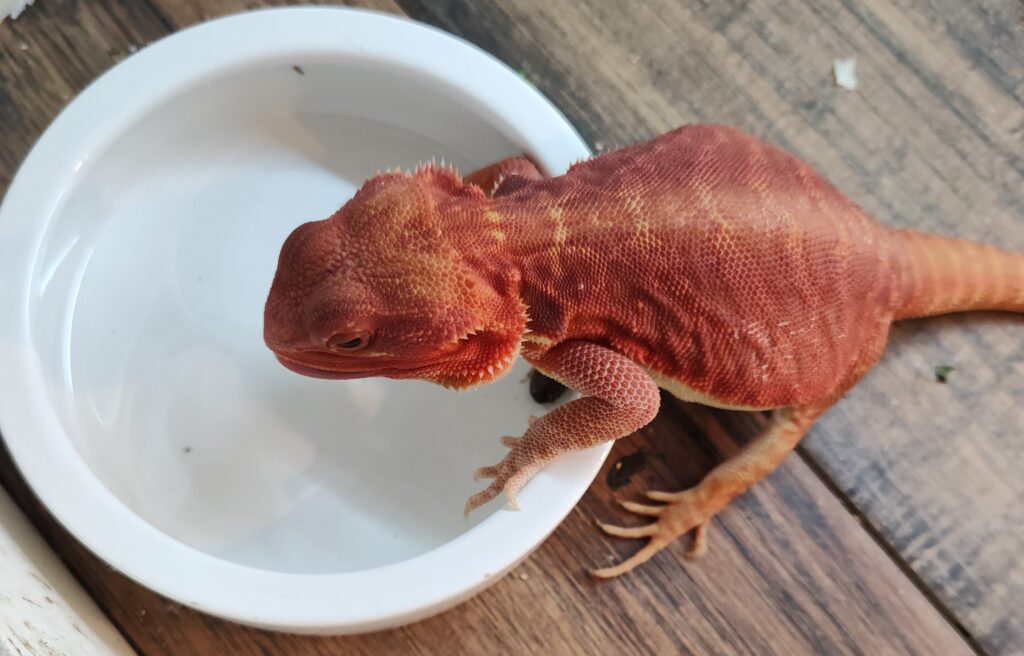
You can provide fresh water for your dragon. It should be in a bowl or dish shallow enough for your Bearded dragon to see into and drink out of. Due to the corrosive action of hot water on copper pipes in hard-water systems, if using tap water, only use cold water for drinking water. Your Bearded dragon will enjoy a shower now and then; a light misting with water will also help keep the skin humidified to make it easier to shed. The tank, however, should never be damp. Bearded dragons are from the deserts of Australia and are not used to high humidity.
You must feed very small prey to baby Bearded dragons. The rule-of-thumb for feeding Bearded dragons says not to feed anything larger that the space between the Bearded dragon’s eyes. When fed prey that is too large for them, serious physical problems can result including: partial paralysis, seizures, ataxia (loss of motor control), inability to self-feed, gut impaction, and even death. Start with feeding small crickets and gradually increase to larger sizes as the Bearded dragon grows. Also offer a daily mixture of greens and veggies for your growing Bearded dragon. Bearded dragons that were raised with greens as a part of their diet are more likely to enjoy greens as an adult.
Bearded dragons consume a wide variety of invertebrates and small vertebrates in the wild, and a variety of protein sources should be offered in captivity. Prey items such as appropriately sized crickets, cockroaches, mealworms, super worms, silkworms, and wax worms can be fed. If you feed freshly molted supers or mealworms, that will reduce the amount of tough, indigestible exoskeleton. Exoskeletons (chitin) can cause intestinal impaction so the least amount ingested the better. As the Bearded dragon reaches adulthood, you can feed less live prey and more vegetarian-based diet as the Bearded dragon’s body no longer requires the high protein diet to grow. Adult Bearded dragons need approx. 50 – 75% vegetarian to 25 – 50% live prey/protein. Remember to dust crickets and worms with a calcium supplement just before feeding them to your Bearded dragon. Adults don’t require as much calcium supplementation as growing Bearded dragons and egg-producing females. Also, don’t forget to use a multivitamin supplement a few times a week.
Make a home for your crickets out of a 10 gallon aquarium or plastic container, and furnish it with pieces of egg crate or cardboard cores from paper towels and toilet paper. Pieces of fruits and vegetables, as well as food such as high-protein baby cereal mixed with reptile vitamins, tropical fish flakes, and rodent chow, all make suitable foods. Since smaller crickets are more nutritious than larger crickets (proportionately less exoskeleton) it is better to feed more of the smaller ones than fewer of the big ones.
Plant matter includes a variety of chopped up vegetables and fruits such as collard and mustard greens, green beans, orange-fleshed squash, escarole, dandelion greens, raspberries, mango, and cantaloupe. Feed fruit less often than veggies and greens because of the higher sugar content in fruit.
It is not wise to feed your Bearded dragon in the evening close to bed time as food will sit in his stomach overnight and could rot. Generally, I don’t feed anything to my Bearded dragons at least two hours before bedtime.
CAGE CLEANING
I recommend the following cleaning/disinfecting products: Nolvasan (odors are not harmful) and bleach (odors are harmful!). Do not mix the two chemicals.
Dilute bleach to a solution of 10% bleach and 90% water for a super strong disinfectant. Anything you spray with bleach must be rinsed well with water and free of any bleach odors before allowed to be returned to your Bearded dragons cage. New cage furnishings such as branches from your yard or rocks should be thoroughly cleaned before added to the enclosure. To clean a branch or rock, soak it in the bleach solution for 30 minutes then bake in the oven at 250 degrees until nice and dry. Heating the wood will kill anything that the bleach happened to miss.
It is a good idea to remove feces everyday as Bearded dragons are notorious for tromping through their poop and getting it everywhere. Also, change the substrate at least once a month or as needed.
HANDLING
Gently scoop up your Bearded dragon with your hand under its belly. Dragons tend to be very trusting and will not necessarily hold on as well as other lizards, so always take care to support your Bearded dragon. They do not like being firmly held; let them rest in your palm. Since Bearded dragons are inquisitive animals, it is always a good idea to create a controlled space in which it may do some exploring. And watch out for the jumpers. One lady e-mailed me and told me about how her Bearded dragon suddenly jumped off her shoulder and landed on the floor. Unfortunately, three days later the same Bearded dragon died of internal injuries from the fall. So keep a close eye on your Bearded dragon and never leave him unattended when out of his cage.
BEHAVIOURS
Arm waving
This is seen in all Dragons contrary to what you may have read. It is a sign of submission. Basically what they are saying is “please calm down, I do not want trouble” or “you are the king and I am not worth the fuss.” Most people believe that if you have two dragons in the same cage the one that waves is the female. This is not 100% accurate. I have seen the males wave to the females. When two males are within sight of each other one will sometimes wave to the other.
Head bobbing
For male Dragons, this simply means I am king. If two males are within sight of each other this is a must. If both males bob aggressively then a fight may result. However, in most cases, the less aggressive male will slow bob his head, while the dominant male bobs will have lots more motion. Females do a slight nod. In new studies, some herpetologists believe they also bob to judge distance.
Push-ups
Sometimes females display what looks to be a push-up in response to male dragons’ head bobs. Most of the time this is seen during breeding season.
Beard displaying
All Bearded dragons will display this behavior but males have much larger beards. This is a sign of aggression or showing off for the females during breeding. Both male and female beards turn black when displayed (males are much darker and some times the darkness spreads down to their shoulders). I have also noticed they display their beards when shedding to help break the skin loose. Also, dragons do what we call “morning exercises.” They puff up their beards in the morning as a way of stretching.
Digging
It’s a fact of life – Dragons dig. They may dig a hole to sleep in, and to get out of the sun. Females dig burrows to lay eggs and this is totally normal. They may also try to dig a sleeping burrow when it’s time to brumate.
Circling and chasing
This is seen in fighting and breeding. Circling with the mouth open means, “I am not turning my back on you,” and it could lead to biting and injuries.
Tail up in the air or tail twitching
If the tail is up or twitching it usually means the Bearded dragon is hunting. Sometimes their tail will twitch when they are watching their prey before they give chase.
Gaping
In a healthy dragon, this behavior is normal. They gape their mouth open to release heat for the same reason a dog pants to cool down. Bearded dragons do not sweat, so they do this to release heat. But, at other times it can be a sign of illness also.
Hissing
Sometimes when startled, both the male & the female will display their beards, open their mouths, and make a kind of hissing noise. This is a defense warning. Don’t be alarmed, Bearded dragons will hardly ever act on their threats. It’s usually all show and no bite.
Bath Time
Bathing is an important part in keeping a healthy dragon. Regular bathing helps keep the Bearded dragon hydrated, clean, and helps to relax the muscles thus making it easier for them to go to the bathroom. Make sure that the bath water is warm to the touch (95-99º F) and fill it just full enough to reach their their back. Remember if it feels too warm to you then it’s definitely too warm for them. Some Bearded dragons are comfortable bathing in the sink or the bath tub and others may not like bath time at all. You can try placing a see-through plastic container on your countertop and gently placing your Bearded dragon inside. He may feel more comfortable resting on your hand while it is submerged in the water. Or you could try rolling up a wash cloth and letting him rest his arms on it. They need to feel secure or they will never enjoy bath time. Be get ready to pick your Bearded dragon out of the bath water should he decide to poop in it.
NEVER LEAVE YOUR Bearded dragon UNATTENDED!