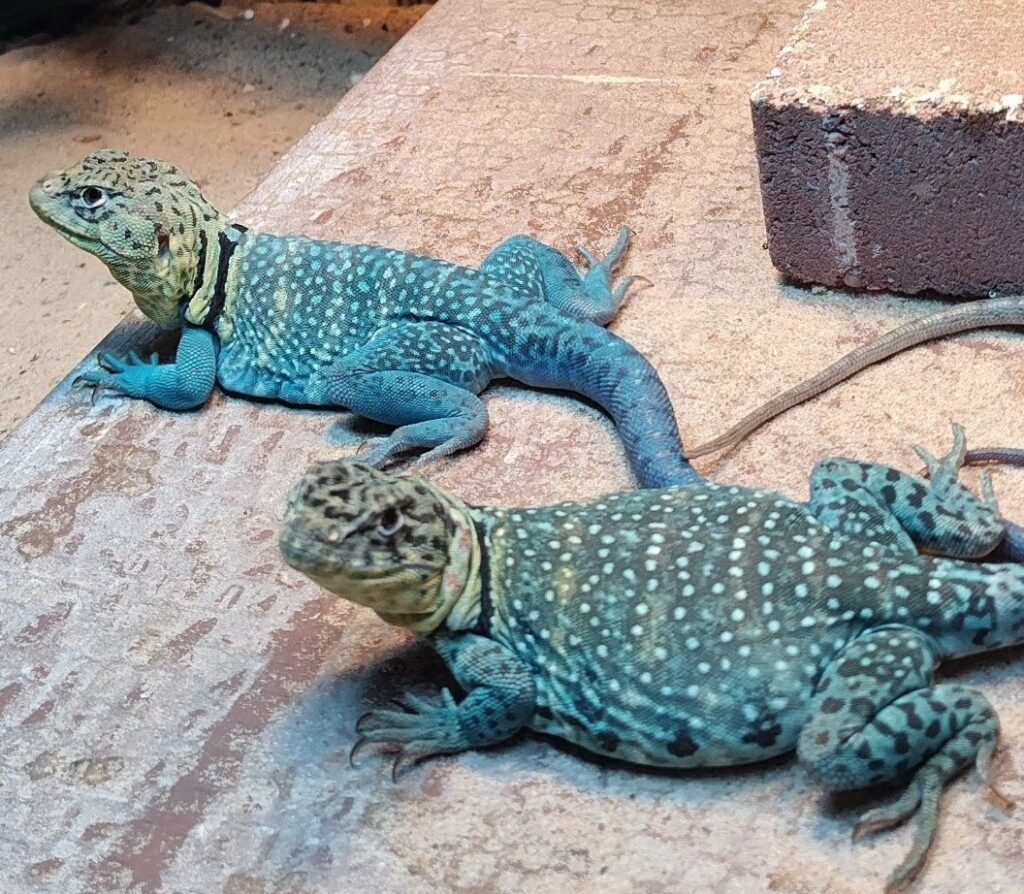
COLLARED LIZARD CARE INFO
Minimum terrarium size for Collared Lizards
The absolute minimum enclosure size for a single collared lizard is 36” x 18” x 18”, or a 40 gallon breeder-style tank. However, collared lizards are very active, so if you can provide larger, your pet will absolutely use the extra space!
It is possible to successfully house multiple collared lizards together. For best results, do not house multiple males in the same enclosure, but one male and multiple females can work. However, cohabitation is optional. Your lizard will be just fine having the terrarium all to itself! If you decide to house more than one, you should definitely get a larger enclosure for them.
Lighting for Collared Lizards
UVB Lighting?
Yes! Collared lizards require UVB lighting for their survival. UVB lighting helps provide a clear day/night cycle, provides all of the vitamin D that your pet needs, strengthens the immune system, facilitates better digestion, and other benefits.
The best paired UVB setups (fixture and correct bulb) for a collared lizard housed in a 36-48” long enclosure are Zoo Med Reptisun T5HO 10.0 or Arcadia Reptile Pro T5 Kit, Desert 12%. Both of these are 24″ fixtures that require 22″ bulbs which are provided if you use the links. The fixture should not cover more than half of the enclosure length. With a two foot fixture in a 36″ enclosure you can angle the fixture so it only is in half of the enclosure.
For best results, house the UVB bulbs in an appropriate reflective fixture as recommended above. The only three fixtures I recommend at this time (lighting improvements are ongoing) are the Arcadia 24” T5HO fixture, the Zoo Med Reptisun 24” fixture or the Vivarium Electronics 24” T5HO fixture (this fixture is made the same way as the Arcadia fixtures). The Vivarium Electronic fixture is less expensive but it also does NOT come with a UVB bulb. They will come with a plant light bulb. You have to buy the UVB bulb separately. The un-named fixture sold by Reptile Basics is the Vivarium Electronics fixture.
Position the lamp on the same side of the terrarium as the heat lamp. If the UVB is mounted over mesh, place the basking surface approximately 9” below the lamp. If the UVB is mounted inside the enclosure, place the basking surface approximately 12” below the lamp.
They are also likely to benefit from plant grow lights as part of their environment as well. Add a ~6500K LED or T5HO fluorescent grow lamp to provide extra illumination, as well as help any live plants in the enclosure to thrive.
Lights should be on for 10 hours/day during winter and 12 to 14 hours/day during summer to simulate seasonal changes in day length. All lamps should be turned off at night.
Basking lights and temperature for Collared Lizards
Collared lizards need a basking surface temperature between 105-120°F, and 75-90°F on the cool side. Temperatures should be measured via infrared thermometer. For best results, use a flat piece of stone such as flagstone, paver stone, or unpolished stone tile as the basking surface. Slate is a good option but unless it is very thick do not place it directly under the basking light as the dark color will cause it to get too hot.
Provide heat for your lizard with a halogen heat bulb placed above the basking surface. Halogen bulbs are the best way to imitate the warmth of sunlight indoors, and considered to be a superior form of reptile heating by experts. Do not use ceramic heat emitters (CHEs), red bulbs, or blue bulbs, as these are not as effective for daytime heat If you need extra heat at night (if your house temps drop below 55 degrees Fahrenheit), you can use a CHE on a thermostat to raise the heat a little at night.
Best humidity levels for collared lizards:
Collared lizards need slightly different humidity depending on which species you’re dealing with. Collared lizards from the western part of their distribution do well between 30-40% humidity, while eastern collared lizard species are more likely to prefer humidity between 50-60%.
However, humidity isn’t something to worry about too much with this species. As long as you have a humid hideout or burrow available, they should be fine. You can keep track of humidity levels with a digital probe hygrometer placed in the middle of the terrarium, and mist occasionally with a spray bottle. Always provide a small bowl of clean water just in case they need more.
Best substrate for collared lizards:
Substrate (aka bedding) covers the floor of the terrarium and helps make the enclosure more attractive, but it also helps maintain healthy joints and provides something for your lizard to dig in (which they love to do!)
We recommend the following substrates for collared lizards:
Substrate should be at least 3” deep and completely replaced every 3-4 months. Remove poop and urates daily, along with contaminated substrate.
How to decorate a collared lizard terrarium:
An empty enclosure makes for a bored collared lizard, reducing its quality of life. Keep your pet entertained and engaged with its environment with the strategic use of décor items that encourage it to exercise natural behaviors!
Since collared lizards are a terrestrial species that prefers rocky terrain, at bare minimum you will need a flat basking stone and a couple of places for them to hide. However, it’s best to include other items, such as:
- secure stacks of flagstone or aquarium slate
- more hiding places
- ledges
- hollow logs
- branches
- live or artificial plants
- dry shrubs
What to feed to a collared lizard:
Collared lizards are insectivores, which means that they need to eat primarily insects to get the right nutrition for their bodies. Live insects should be offered every morning, as many as your lizard will eat in one day. Juveniles generally eat a higher quantity of insects than adults.
Variety is the key to a balanced diet, so make sure to offer as many different types of insects as possible.
Feeder insects for collared lizards: dubia roaches, discoid roaches, red runner roaches, crickets, black soldier fly larvae, hornworms, mealworms
Supplements
You will also need calcium and vitamin supplements to help keep your collared lizard healthy. We recommend Repashy Calcium Plus LoD, lightly dusted on all insects. It’s okay to occasionally skip a dusting.
Water
Of course, don’t forget a small water bowl for your lizard to drink from! Change the water daily and scrub the bowl with a reptile-safe disinfectant weekly, or whenever it becomes soiled.
How to handle your collared lizard:
Many reptiles generally don’t appreciate petting and handling in the same way that dogs and cats do. Some collared lizards learn to tolerate it or even enjoy your company though. I usually have my babies fairly tame when you get them. I get them used to crawling up on my hand by putting them in a large tub (at least 14″ tall) and just placing my hand on the bottom and letting them crawl into it on their own. They do like the warmth of your hand so that helps. Also, if you want to bond with your collared lizard, try hand-feeding it with feeding tweezers or put a mealworm or small superworm in your hand and let them crawl into your hand to get it. With patience and time, you can get them tame enough to crawl into your hand on their own.
Please feel free to contact me at any time if you have issues or questions! I care about all my reptiles and my customers! Email me at fgdragons@outlook.com or contact via my facebook page at www.facebook.com/fgdragons
Enjoy your new pet!